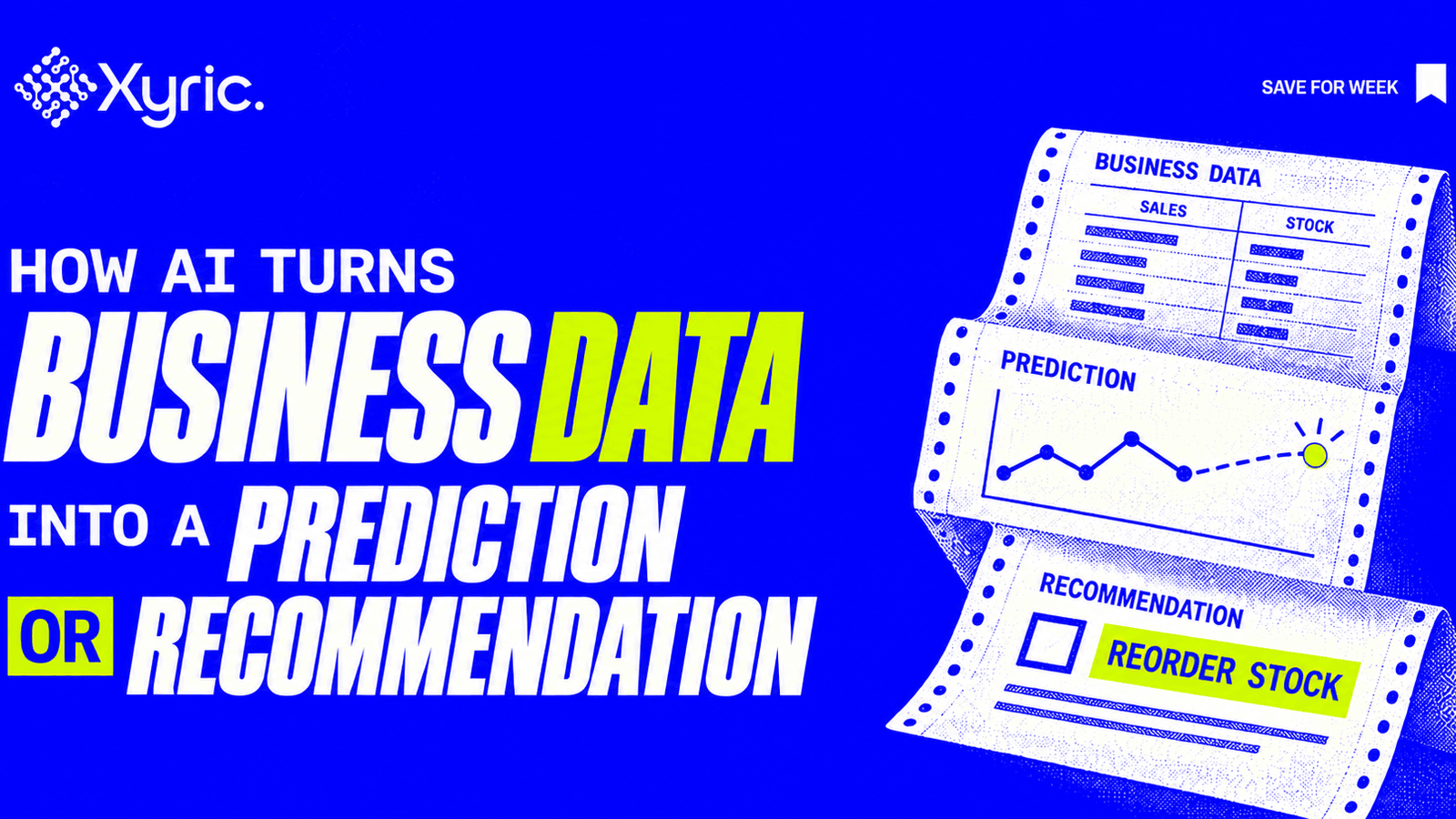
AI does not turn a spreadsheet into an answer by magic. A team must define the target, prepare examples, test error, and decide how the prediction changes real work. A sales director opens a forecast and sees that one product may run short next month. The number looks precise. What the screen does not show is the chain of choices behind it. Someone defined what “demand” means. Someone selected the historical records. Someone decided how to handle cancelled orders, promotions, missing inventory, and new products. Someone chose the error measure. Someone still needs to decide whether to buy more stock. The prediction is the clear end of a much larger system.
Quick answer: AI turns business data into a prediction by learning relationships between past inputs and known outcomes. A useful system defines the target, prepares relevant examples, compares the model with a baseline, tests it on unseen cases, and connects the output to a decision with clear ownership and monitoring.
Start with the decision, not the dataset
The first question is not “What data do we have?” It is “What choice should improve?” A vague goal such as “predict sales” can hide many other jobs:
- Estimate total monthly revenue for finance planning
- Forecast daily units by product and site for replenishment
- Find accounts likely to miss a target
- Estimate the effect of a planned promotion Each job needs another target, time horizon, level of detail, and response. Write the choice in one sentence:
Each Thursday, the inventory manager uses a four-week demand forecast by product and site to review purchase quantities for the next order cycle. That sentence names the user, timing, prediction, detail, and action. It gives the project a boundary.
Define the outcome the model must learn
Machine-learning teams often call the outcome a label or target. It is the answer found in the historical examples. For demand forecasting, the target might be units sold in a given week. That sounds simple until the business asks whether cancelled orders, returns, stockouts, transfers, and free promotional units count. If the definition changes across teams or time periods, the model sees inconsistent examples. The project then has a data-governance problem before it has a modelling problem. Google's Rules of Machine Learning recommends choosing a simple, observable objective and building metrics before formalizing the machine-learning system. The advice is practical because a measurable starting point makes later improvement visible.
Choose inputs that would exist at prediction time
Inputs used by the model are often called features. For a demand forecast, they may include:
- Product and site
- Historical sales
- Price and discount
- Promotion schedule
- Inventory availability
- Day of week and season
- Holidays or known events The timing matters. A model cannot fairly use information that becomes available only after the prediction is made. Doing so creates leakage: testing looks excellent because the model has seen clues that will not exist in real use. The team should also record the source, owner, freshness, and permitted use of each key input. A feature with no owner can quietly become stale.
Prepare the historical examples
Real business data contains copies, gaps, late updates, changed codes, and rare events. Preparation is not cosmetic cleaning. It decides what the model is allowed to learn. The team needs to answer questions such as:
- Are dates and time zones steady?
- Did a zero mean no demand or no stock?
- Were product IDs reused?
- Did a system migration change a field?
- Are returns linked to the original sale?
- Are major events represented or excluded? A clean-looking table can still carry the wrong business meaning. Data review must include someone who understands how the records were created.
Build a baseline before a complex model
A baseline is a simple method that the AI system must beat. For demand, the baseline might be last week's sales, the same week last year, or a seasonal average. For risk, it might be an existing rule. For lead ranking, it might be recency plus company size. Without a baseline, the team may celebrate a sophisticated model that performs no better than a calculation already available in a spreadsheet. A baseline also keeps the business question honest: does the new system improve the decision enough to justify its cost, complexity, and maintenance?
Test on cases the model did not learn from
Test should simulate real use. Time-based problems often need time-aware testing so future records do not leak into the past. The measure must match the impact of an error. An average forecast error can hide large misses on the products that matter most. A fraud model may need a different balance between missed fraud and false alarms. A lead score may need to be judged by whether the top-ranked leads produce useful conversations. Use more than one measure when the business has competing goals. A restaurant trying to reduce food waste should also track stockouts. Optimizing one without the other can create a worse service outcome.
Turn the prediction into a controlled action
A prediction is not a choice. The workflow must say:
- Who sees the result
- What supporting information appears beside it
- Which threshold or range matters
- What action is available
- When a person may override it
- What happens when the model is unavailable
- How the final choice is recorded For the inventory case, the model may recommend a range rather than a single number. The manager can compare it with current stock, supplier lead time, and upcoming promotions before approving the order.
Monitor the system after launch
Business conditions change. Product mix shifts, customer behaviour changes, data pipelines break, and rules evolve. Tracking should cover three layers:
- Data: Are key fields present, fresh, and within planned ranges?
- Model: Is prediction quality changing for key groups or periods?
- Business: Are decisions and outcomes improving without unacceptable side effects? The NIST AI Risk Management Framework treats measurement and management as continuing work. A model should not receive permanent trust because it passed one launch test.
A short prediction checklist
A prediction needs a clear target.
- A prediction needs past cases.
- A prediction needs clean labels.
- A prediction needs a fair test.
- A prediction needs a simple baseline.
- A prediction needs a known time frame.
- A prediction needs fresh input.
- A prediction needs an error limit.
- A prediction needs a named owner.
- A prediction needs a real next step.
- A prediction needs a safe fallback.
- A prediction needs checks after launch.
- A prediction needs review when the market shifts.
Do not ask whether the prediction looks smart. Ask whether it helps a real choice. A weak prediction may still help when the cost of review is low. A strong prediction may be unsafe when one wrong result can cause major harm.
A safe first test
Pick one choice that the team makes often. Use old cases where the final result is known. Hide some cases from the tool, then use them for the test.
Show the result to the people who make the choice today. Ask whether it came in time and whether it changed what they did. Record wrong calls as well as right ones. Look at the harm caused by each kind of error. If the new method does not beat a basic rule or the current process, fix it before anyone relies on it.
Frequently asked questions
Does AI need a large amount of data to make predictions?
The answer depends on the task, variation, model, and quality of the examples. A smaller, well-defined dataset may be more useful than a large archive with unclear targets or inconsistent records. Start by checking whether the data represents the decision you want to support.
What is the difference between a prediction and a recommendation?
A prediction estimates an outcome, such as expected demand. A recommendation suggests an action, such as increasing an order. Recommendations often combine predictions with business rules, costs, limits, and human judgment.
Can a business use AI predictions without a data scientist?
Teams can use products with built-in predictive features, but someone still needs to define the target, validate the data, test results, know limitations, and own the choice. The title matters less than the responsibilities.
How often should a predictive model be reviewed?
Review frequency should match how quickly the data and decision environment change. Monitor continuously for broken inputs and schedule business reviews. High-impact or rapidly changing use cases need closer attention. Related reading: Why data quality matters before analytics or AI Book a discovery call to turn one business decision into a testable prediction problem with a clear baseline. Service connection: Xyric Optimize Case to examine: How Bank CenterCredit changed reporting from weeks to hours