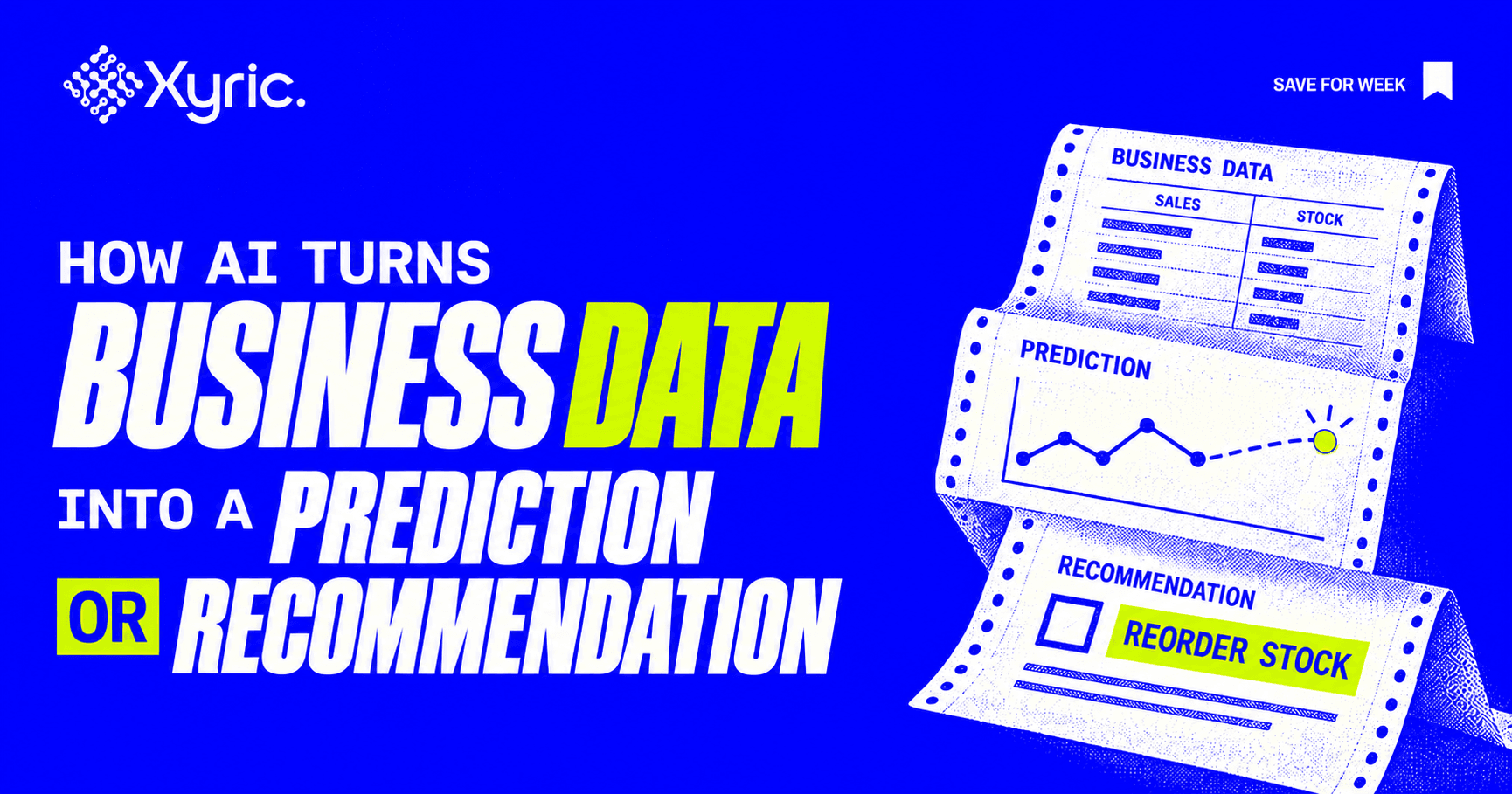
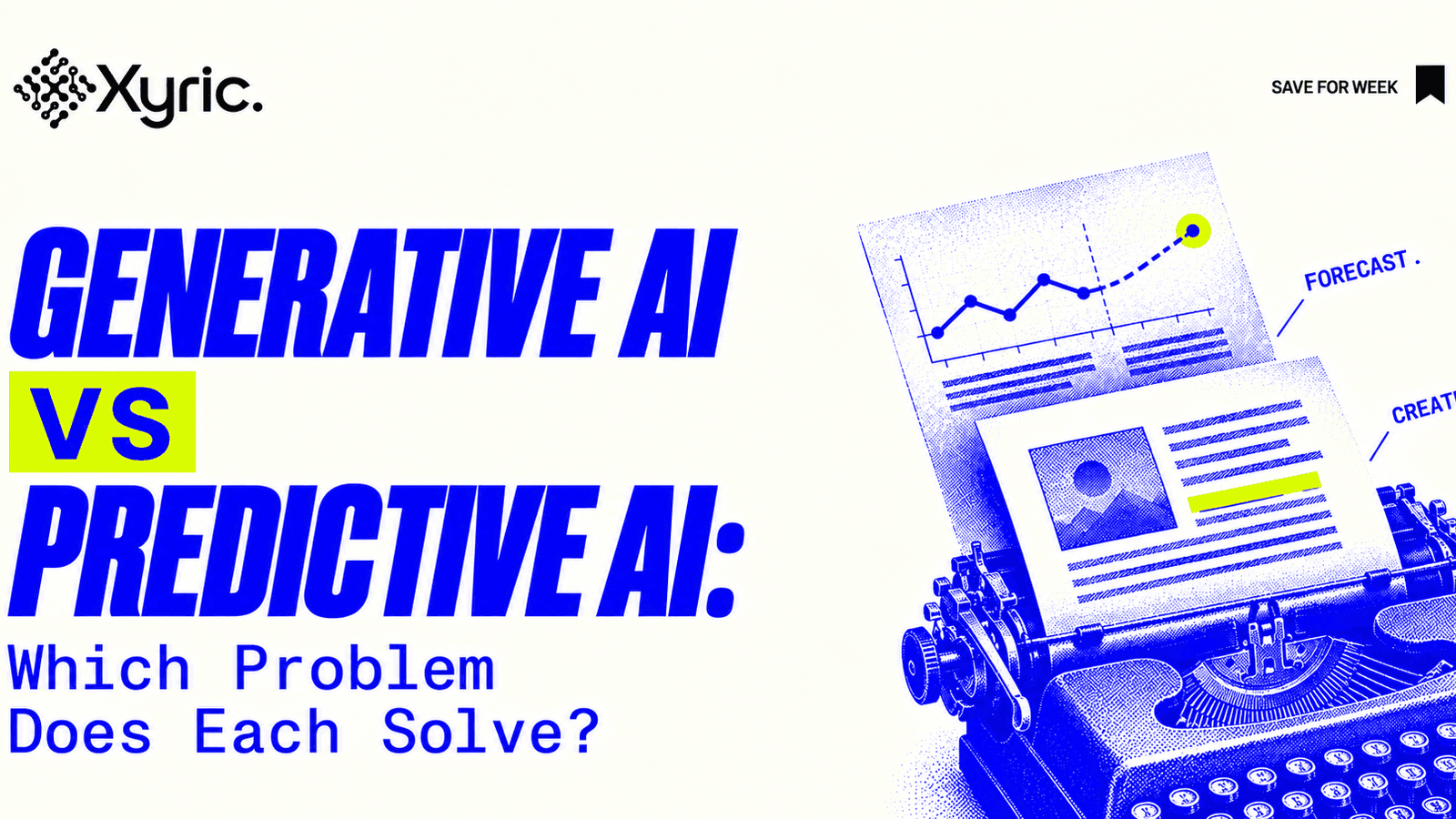
A chatbot drafting a reply and a model forecasting next month's demand both use AI, but they solve different problems and need different evidence. A retail manager asks two questions. First: “How many units are we likely to sell next week?” Second: “Can you draft a supplier update explaining the planned change?” The first question asks for an estimate of a future outcome. The second asks for new language. Calling both tasks “AI” is correct, but not helpful enough to guide the project.
Quick answer: Predictive AI estimates a likely outcome, score, class, or value from historical patterns. Generative AI creates new text, images, audio, code, or other content from instructions and context. Businesses may use both, but each needs different data, evaluation, controls, and workflow design.
What is predictive AI?
Predictive AI uses historical examples to estimate an outcome for a new case. The output might be:
- A demand forecast
- A probability that a customer will leave
- A fraud-risk score
- A predicted delivery time
- A classification such as urgent or routine
- A recommended ranking of products or leads The business must define the target clearly. “Predict customer behavior” is too broad. “Estimate the probability that an active subscriber will cancel within 30 days” is clear enough to discuss data, evaluation, and action. Predictive models also need a comparison. A complex model is not automatically valuable if a simple seasonal average or business rule performs almost as well. Google's Rules of Machine Learning recommends starting with measurable objectives, simple models, and dependable pipelines.
What is generative AI?
Generative AI produces new content based on patterns learned during training and the context supplied in the request. The output might be:
- A draft email
- A file recap
- A product description
- An image
- A code suggestion
- A structured answer from source content
- A proposed set of next steps Large language models generate text by predicting tokens in sequence. Google's introduction to large language models explains how tokens, context, parameters, and self-attention contribute to this process. The generated output can be helpful without being guaranteed correct. A fluent paragraph may include an unsupported claim. Test therefore needs to check accuracy, completeness, source support, tone, safety, and task-specific requirements.
The central difference is the output
Predictive AI answers a question such as:
- What is likely to happen?
- Which class does this case belong to?
- How risky is this transaction?
- Which item should appear first? Generative AI answers another type of request:
- Write a first draft.
- Summarize these records.
- Explain this result.
- Create an image or piece of code. The distinction is not perfect. A language model predicts tokens to generate text, and a predictive system may produce an explanation. From a business-planning perspective, however, the difference helps teams define the expected output and how they will test it.
A practical example using both
Consider a multi-site retailer preparing for a promotion. The predictive system estimates unit demand by product and location. It uses sales history, price, promotions, seasonality, inventory availability, and relevant events. The operations team checks the forecast against a baseline and reviews large changes. The generative system then drafts a plain-English planning note. It explains which locations may need more inventory, which assumptions shaped the forecast, and which categories need attention. The two outputs should not be confused. The forecast must be tested for error, stability, freshness, and business impact. The written note must be checked against the forecast and source data. A clear explanation cannot rescue a poor forecast, and a good forecast can still be misrepresented by a weak summary.
What data does each approach need?
Predictive AI needs labelled or measurable outcomes
A demand model needs historical demand. A churn model needs a clear definition of churn. A fraud model needs examples and investigation results. If the target is unclear or inconsistently recorded, the model learns from a moving definition.
Generative AI needs relevant context and instructions
A model drafting a supplier note needs the forecast, approved terminology, intended audience, format, and boundaries. If the task needs current business information, the workflow may retrieve approved source content rather than relying on the model's general training. Read Training data, prompt context and retrieval for a deeper explanation of those three information sources.
How should each system be evaluated?
Predictive AI may be tested with error measures, precision, recall, calibration, ranking quality, or business metrics tied to the decision. The correct metric depends on what an error costs. Generative AI needs task-specific review criteria. A support draft might be assessed for factual support, rule compliance, completeness, tone, and correct handoff. A recap might be judged on whether it preserves critical facts and clearly marks doubt. Both need real examples from the intended workflow. A general benchmark cannot tell you whether the system handles your rules, edge cases, data quality, and users.
Which approach should your business choose?
Start with the question.
- Choose predictive AI when the business needs a score, forecast, class, or ranking.
- Choose generative AI when the business needs new content or a language-based transformation.
- Use both when a forecast needs to be explained or turned into a working draft.
- Use ordinary rules when the conditions are stable and clear.
- Keep a person involved when the choice is high-risk, rare, or hard to reverse. Do not begin by buying a model and searching for a use case. Define the decision, baseline, available data, acceptable error, and workflow first.
A quick generative AI check
Use generative AI when the main job is to make or reshape content. It can draft text, sum up notes, and change tone. Generative AI can also help a person search long files.
Ask these questions first:
- Does generative AI have the facts it needs?
- Can the user see the source?
- Can a person check the output with care?
- What harm could a false claim cause?
- What should generative AI refuse to do?
Generative AI is a poor fit for a strict rule that must work the same way each time. A basic rule is often safer for that job. Generative AI is also not a forecast tool by default. If the goal is to score risk or guess demand, a predictive model may fit better.
Start small. Give generative AI one clear task and a short set of trusted facts. Test common cases and hard cases. Track what users change. Those edits show where generative AI needs better facts, a tighter rule, or a human handoff.
Keep the final check with the person who owns the work and can judge the harm of a poor result.
A simple way to choose
Start with the result you need. If you need a score, risk level, or sales forecast, test a predictive tool. If you need a draft, summary, or reply, test a generative tool.
Use one real case first. Give the tool clean facts and a clear goal. Check the result with the person who does the work now. Note what was right, what was wrong, and what was missed. This small test will show whether generative AI fits the job. It will also show where a rule, a data check, or a person must stay in the flow.
Keep the first test small and easy to stop.
Frequently asked questions
Is ChatGPT generative AI or predictive AI?
ChatGPT is a generative AI product built on language models that predict tokens to produce responses. In business use, it is described as generative AI because the visible output is newly generated language.
Is forecasting generative AI?
Traditional demand, revenue, and risk forecasting is often predictive AI. Some generative models can produce forecasts or explanations, but the business should still test the forecast with suitable forecasting measures.
Can generative AI use predictive-model results?
Yes. A workflow can pass a forecast or risk score to a generative model and ask for a summary. The generated explanation must stay grounded in the actual model output and source data.
Which type of AI is safer?
Neither is safer on its own. Risk depends on the use case, data, users, controls, and impact of an error. Both need evaluation, ownership, and monitoring suited to the decision. Book a discovery call to match one business question with the simplest useful AI approach. Service connections: Xyric Optimize and Xyric Launch Case to examine: What the Klarna AI support case can teach business teams