
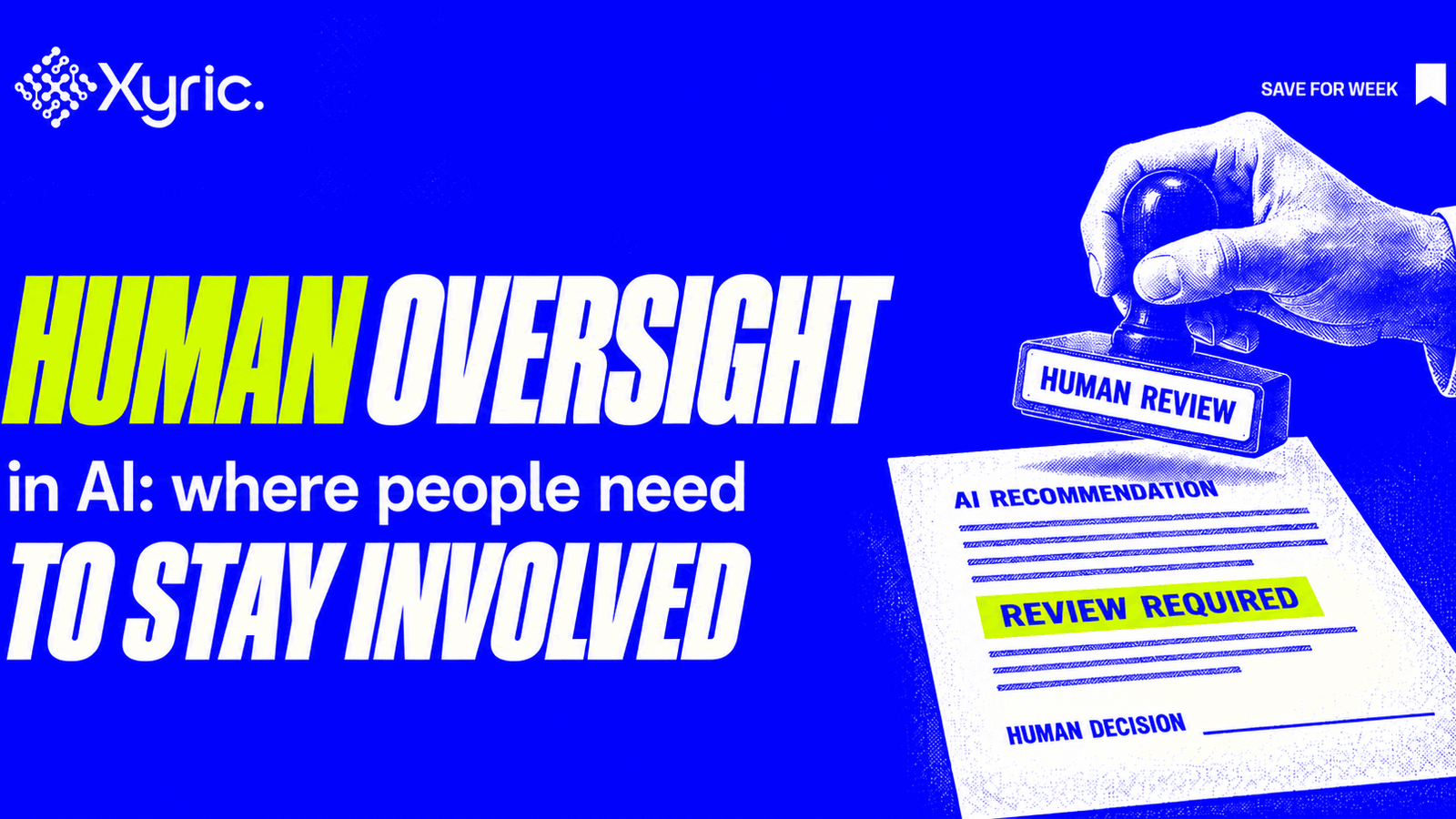
Adding a sign-off button does not make an AI workflow safe. The reviewer must know the case, see the proof, challenge the output, and stop the process when needed. An AI system recommends rejecting a supplier invoice. A finance employee sees a red warning, clicks “confirm,” and moves to the next item. The system technically included a human. The person did not see why the invoice was flagged, which fields were uncertain, or whether the model had misread a handwritten amount. The sign-off step existed, but meaningful oversight did not.
Quick answer: Human oversight in AI means a qualified person can know the case, review useful proof, question the model's output, make or approve the choice, and stop or change the workflow. Oversight must happen at the point where human judgment can still affect the outcome.
What does human oversight actually mean?
Human oversight is often reduced to “a person stays in the loop.” That phrase hides many other responsibilities. A person may need to:
- Approve an action before it occurs
- Review uncertain or rare cases
- Correct a generated draft
- Investigate a warning
- Decide whether a rule edge case applies
- Monitor results across many cases
- Pause the system when risk increases
- Change the model, prompt, data, or rules The right responsibility depends on the business impact. A person reviewing a marketing draft performs another role from a claims specialist deciding whether a customer receives a payment.
Where should people stay involved?
Keep human judgment where the work contains one or more of these conditions.
The decision affects rights, access, money, safety, or employment
High-impact choices need stronger accountability, proof, and review. AI may prepare facts, but the authorized person should own the choice.
The case falls outside the normal pattern
Known edge cases, missing facts, clashing records, and low-confidence outputs should move to a review path.
The action is difficult to reverse
Publishing a draft internally is easy to undo. Sending money, denying service, changing a legal record, or contacting a customer with a commitment is not.
Context lives outside the system
A model may not know about a recent customer chat, temporary rule, local event, or day-to-day constraint. A person can bring that context into the choice.
The system is still being tested
Early pilots need closer review so the team can learn which cases fail and why.
What makes oversight meaningful?
Meaningful oversight needs more than human presence.
The reviewer has the right information
Show the original request, useful source content, model output, doubt, prior actions, and reason the case needs review. Do not send a person a warning with no context.
The reviewer understands the task
The person needs enough subject knowledge to recognize a wrong answer. A random approver does not create control.
The reviewer has time
If one employee must approve hundreds of cases under a strict timer, the workflow encourages automatic acceptance. Review capacity is part of system design.
The reviewer has authority
The person must be able to reject, edit, escalate, or stop the action. A read-only screen after the choice has already occurred is tracking, not sign-off.
The reviewer knows the quality standard
Define what counts as correct, incomplete, unsafe, or uncertain. Otherwise, reviewers apply inconsistent personal judgment.
Choose the right review pattern
Other workflows need other patterns.
Human before the action
AI prepares a recommendation or draft. A person approves it before anything changes. Use this pattern when errors carry meaningful consequences.
Human for exceptions
Routine cases follow a controlled automated path. Missing data, low confidence, rule edge cases, or rare values move to a person. Use this only when routine cases are well defined and monitored.
Human after the action
The system acts, and people review samples or alerts afterward. This may fit low-risk, reversible work. It is weak for choices that can harm someone before review.
Human monitors the system
A named owner reviews aggregate results, failure patterns, complaints, overrides, and data changes. Every production workflow needs this layer, even when individual cases receive review.
Design a useful escalation
A handoff should answer five questions:
- Why did the system stop?
- What facts did it receive?
- What did it produce or attempt?
- What choice does the person need to make?
- What happens after the choice? Consider a customer-refund workflow. AI extracts the request and order details. Rules check the refund window and product category. Routine cases within policy can be prepared for approval. Missing records, unusual damage claims, repeated requests, or policy conflicts move to a specialist. The specialist receives the full conversation, order history, policy section, extracted details, and reason for handoff. The customer does not need to repeat the story. This case makes no results claim. It shows what helpful context looks like.
Prevent review from becoming a rubber stamp
Automation bias occurs when people over-trust a system because it often appears correct or because disagreeing needs extra work. Reduce that pressure by:
- Showing proof, not only the advice
- Making edit and reject actions easy
- Recording why reviewers override the system
- Sampling approved cases for quality review
- Rotating or balancing heavy review work
- Training reviewers on common failure modes
- Avoiding interfaces that imply certainty where none exists The NIST AI Risk Management Framework describes governance, mapping, measurement, and management as connected responsibilities. Oversight should feed those activities. Reviewer corrections are evidence for improving the workflow.
Decide who can stop the system
Each AI workflow needs a stop condition and a named owner. Possible stop signals include:
- A critical error
- A sudden increase in fixes
- Missing or stale input data
- A rule change
- A security or privacy incident
- A new user group or purpose
- Complaints that reveal an untested harm The fallback should already exist. People need to know how work continues safely while the system is paused.
Build a review step people can use
A review step must have a clear job. Do not ask a person to "check the AI" with no guide. Tell them what to check and what they may change.
A sound review guide covers:
- The facts that need proof
- The rules that must be met
- The signs of harm or bias
- The actions the person may approve
- The cases that must be sent to an expert
Show the source beside the output. The review will be slow if the person must search from the start. Give them a clear way to fix the result or reject it.
Set enough time for review. A rushed check can turn into a tick-box step. It may look safe on paper while poor work still goes through.
Track what the review finds. Group errors by cause and risk. If the same fault keeps coming back, fix the source, rule, prompt, or tool. Do not make staff catch the same fault forever.
The level of review should match the harm. A low-risk draft may need a quick check. A choice about money, rights, safety, or jobs needs deeper care. Human review works best when people have the proof, time, skill, and power to stop the action.
A quick review test
Give the reviewer one real case. Ask them to find the source, spot a fault, correct it, and stop the next step. Time the work. Then ask what was hard to see or change.
This test shows whether the review is real. A person cannot protect the customer if the source is hidden or the stop button does not work. The same is true when staff have no time to think. Fix those gaps before the tool handles more work. Repeat the review test when the rule, source, model, or risk changes.
Frequently asked questions
Does every AI output need human approval?
No. Review should match the risk, doubt, and reversibility of the task. Low-risk drafts may only need user editing, while high-risk choices may need formal sign-off by an authorized specialist.
What is the difference between human in the loop and human oversight?
Human in the loop often describes a person participating in individual cases. Human oversight is broader. It includes case review, monitoring, governance, handoff, correction, and authority to stop or change the system.
Can confidence scores decide which cases people review?
They can support routing when the scores are tested and understood. Confidence alone should not replace business rules, risk categories, data-quality checks, or review of known edge cases.
Who should own an AI workflow?
Ownership should include a business owner responsible for the outcome and tech owners responsible for the system. Risk, legal, security, data, or domain specialists may also be needed depending on the use case. Related reading: How to design human review and exception handling Book a discovery call to define the decisions, evidence, authority, and stop controls for one AI workflow. Service connections: Xyric Optimize and Xyric Launch Case to examine: What the Klarna AI support case can teach business teams
Sources
- NIST AI Resource Center and AI Risk Management Framework, accessed 2026-10-15.
- Recommendations for implementing automation, Microsoft Learn, updated 2026-04-08.
- Rules of Machine Learning, Google for Developers, accessed 2026-10-15.