
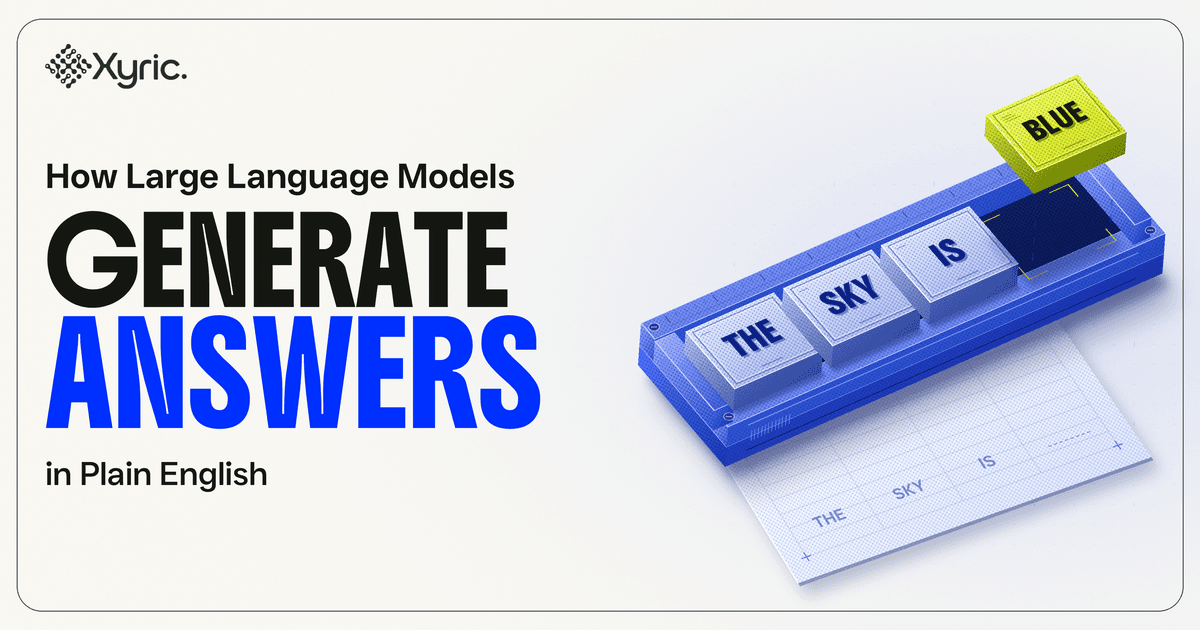
An LLM does not retrieve a finished paragraph from a hidden library. It builds the response one token at a time from patterns, instructions, and the context available now. You ask a language model to explain a contract clause. The answer appears as a complete paragraph, which makes the process feel like search. Underneath, the model is doing something other. It processes the text as tokens, represents relationships in the context, predicts a likely next token, adds it, and repeats the process until the response ends.
Quick answer: A large language model turns text into tokens, represents those tokens as numbers, uses attention to weigh their relationships, and predicts the next token repeatedly. Training teaches broad language patterns. The prompt and current context guide the answer, but neither guarantees that each generated statement is true.
What is a language model?
A language model estimates how likely a token or sequence of tokens is within a context. Google's introduction to large language models explains language modelling as probability over token sequences. Earlier language models used shorter patterns. Modern large language models use transformer architectures and many parameters to work with broader context and more complex relationships. “Large” often refers to scale: training data, parameters, computation, or a combination. The label does not mean the model knows every fact or understands a business exactly as a person does.
Step 1: Text becomes tokens
The model does not process words exactly as people see them. A tokenizer divides text into units that may be whole words, parts of words, characters, punctuation, or spaces. For example, a company name or technical term may become many tokens. Other models and languages can split the same text differently. Tokens matter because model limits and much API usage are measured through them. Read What AI tokens are and how they affect usage for the business implications.
Step 2: Tokens become numerical representations
The model converts tokens into vectors, which are numerical representations. During training, these representations capture useful relationships between language patterns. Words used in similar contexts may develop linked representations, but the model is not storing a human dictionary term beside each token. Meaning emerges from learned statistical relationships and the current sequence.
Step 3: Attention weighs the context
Transformers use attention mechanisms to weigh relationships between tokens in the context. A pronoun may relate to a name earlier in the paragraph. A qualification at the end of a rule sentence may change how the first clause should be read. Attention helps the model use useful parts of the context when forming the next representation. It does not create perfect comprehension or guarantee that the model will preserve each key detail.
Step 4: The model predicts the next token
The model produces probabilities for possible next tokens. A decoding process selects one based on the model settings and available options. The selected token becomes part of the context, and the model predicts again. This repeat process produces sentences, paragraphs, and longer responses. Because generation is probabilistic, the same prompt may produce other wording or logic. Settings can make output more or less varied, but they do not turn generation into checked search.
What did training teach the model?
Training exposes the model to large amounts of data and adjusts its parameters so it becomes better at forecast. More methods can help it follow steps, respond more safely, or perform particular tasks. Training creates broad capability. It does not guarantee current knowledge, exact recall, permission to use a company's private data, or reliable answers for every domain. A business should treat model training, supplied context, and connected tools as separate sources of capability.
What happens when you send a prompt?
At use time, often called inference, the model receives a context that may include:
- System steps
- The user's message
- Earlier chat
- Attached files or retrieved passages
- Tool definitions
- Output-format rules The model uses this context to generate the response. If the context is vague, clashing, outdated, or missing a source, the answer may still sound polished while being wrong.
Why are LLMs useful for business work?
Language is the main content in many business tasks. LLMs can assist with:
- Classification of open-text requests
- Facts extraction
- Summaries
- Drafts
- Translation
- Question answering from approved sources
- Converting unstructured text into a defined format The task becomes safer when the input, planned output, source content, and review rules are clear.
What are the main limits?
An LLM can:
- Generate unsupported details
- Miss an edge case
- Follow a harmful or off-topic step in supplied content
- Use stale knowledge
- Lose key context in a long request
- Produce other answers to similar prompts The control depends on the use case. A low-risk internal draft may only need editing. A rule answer should be grounded in approved files and reviewed. An external action needs access rights, logs, and a safe handoff path.
A practical example
Consider a support assistant for an industrial supplier. A customer describes a problem in ordinary language. The model classifies the request, extracts the equipment type and serial number, retrieves useful troubleshooting guidance, and drafts a reply. Rules check whether needed details are missing. Safety-linked cases go to a specialist. The model helps with language; it does not own the tech choice.
What happens in plain words
The tool reads your text in small parts. It turns those parts into numbers. It then looks at the parts that came before and works out what may come next.
It does this one step at a time. The first step shapes the next one. That is why two replies can start in the same way and then move apart.
The tool does not open a hidden book of facts for each reply. It uses patterns learned in its training, plus the text and files you give it now. If you link it to a search or file store, it can use that new text as well.
The tool has limits. It may miss a key detail. It may join two facts in the wrong way. It may write a claim that sounds sure even when the evidence is weak.
You can reduce that risk. Give it a clear task. Use trusted facts. Ask for sources. Set a format. Test hard cases. Keep a person in charge when the result can affect money, rights, safety, or trust.
The main point is simple: fluent text is not the same as sound evidence. Judge the reply by its facts and its use, not by how smooth it sounds.
Frequently asked questions
Does an LLM understand language like a person?
An LLM represents and predicts language patterns at great scale. It can perform tasks that look like understanding, but it does not share human experience, responsibility, or guaranteed factual knowledge.
Does an LLM search the internet for every answer?
No. A base model generates from learned patterns and current context. Some products add web search, search, or tools. Those are linked capabilities, not automatic properties of each LLM response.
Why do LLM answers change?
Generation is probabilistic, and small differences in prompt, context, model version, settings, or available tools can change the output.
Can an LLM use company documents?
Yes, when the product and access rights support file context or search. The business still needs access controls, source quality, evaluation, and review. Book a discovery call to define where an LLM can assist one language-heavy workflow without owning the final decision. Service connections: Xyric Optimize and Xyric Launch Case to examine: What the Klarna AI support case can teach business teams
Sources
- Introduction to Large Language Models, Google for Developers, accessed 2026-10-15.
- Understanding and counting tokens, OpenAI Help Center, accessed 2026-10-15.
- NIST AI Resource Center, accessed 2026-10-15.