When an AI answer is missing a business fact, adding more training is not always the answer. The system may need better context or retrieval from an approved source. A rule team updates its travel rules on Monday. On Tuesday, an employee asks an AI assistant about the new meal allowance. The model's original training cannot contain a rule that changed yesterday. The answer must come from facts supplied now, often through the prompt or a retrieval system linked to the approved rule library.
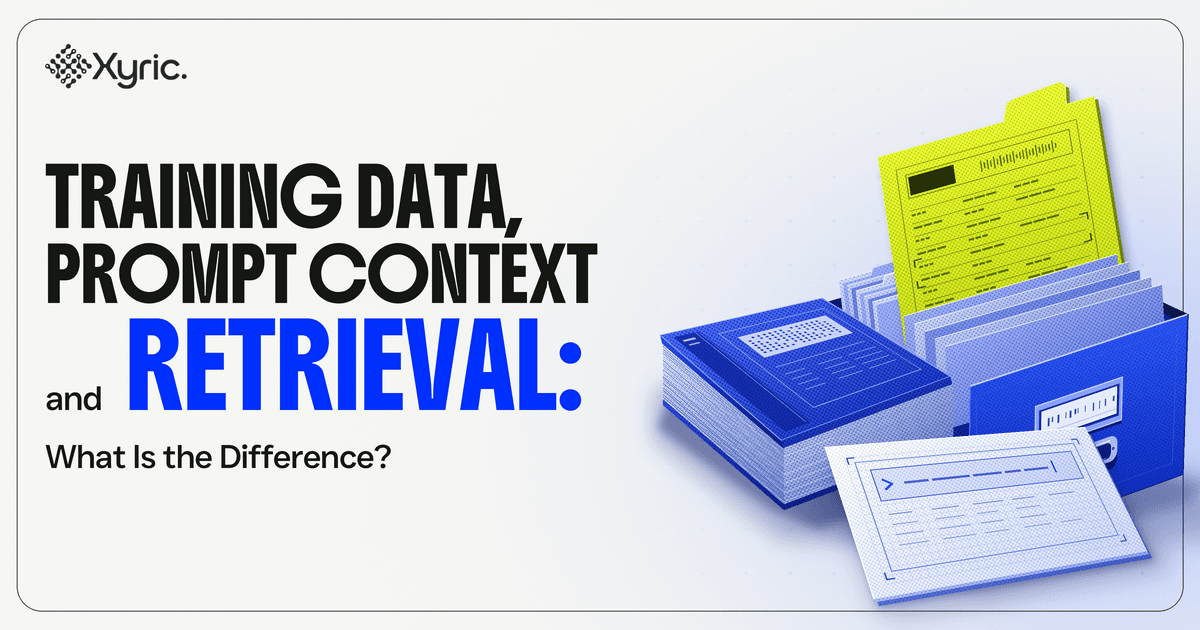
Quick answer: Training data shapes a model's general capabilities before use. Prompt context supplies steps and facts for the current request. Retrieval searches an external knowledge source and adds useful passages to that context. They solve other problems and should not be treated as interchangeable.
What is training data?
Training data is the content used while building or adapting a model. During training, the model's parameters change as it learns patterns. Broad pretraining can create general language ability. More training or fine-tuning can shape behaviour or results for a narrower task. Training is not the same as uploading a file for one question. It is also not a reliable database lookup. The model learns patterns rather than storing each source as a guaranteed, current record. Training can help when a team needs steady task behaviour across many examples. It is often a heavier intervention than supplying context or retrieval and needs careful data preparation and test.
What is prompt context?
Prompt context is the information available to the model during the current request. It may include:
- System steps
- The user's question
- Examples of good output
- Conversation history
- Attached text or files
- Retrieved source passages
- Tool definitions
- Output-format requirements Context can change from one request to the next. It is helpful for explaining the job, giving current facts, and showing the planned result. The context window limits how much the model can process at once. Filling it with repeat or off-topic content can make the request more expensive and harder to control.
What is retrieval?
Retrieval finds facts from an external source at the time of the request. The system then adds selected passages to the model's context. This pattern is often called retrieval-augmented generation, or RAG. Microsoft's RAG guidance describes retrieval and indexing as ways to bring private or domain-specific knowledge into generative AI applications. A retrieval workflow often:
- Receives the user's question.
- Searches an approved index or knowledge source.
- Selects useful passages.
- Adds them to the model context.
- Instructs the model to answer from those passages.
- Returns the answer with source references. Retrieval helps with current or proprietary facts. It does not on its own solve weak source quality, poor search, clashing files, or unsupported logic.
When should a business use each one?
Use training or fine-tuning when the problem is repeat behaviour that prompting alone does not handle well, and when you have suitable examples and test. Use prompt context when the model needs steps, a small amount of current facts, a format, or a few examples for the present task. Use retrieval when the answer depends on a larger, changing body of approved knowledge such as rules, product files, case histories, or procedures. Many systems use all three. A capable model follows current instructions and retrieves business knowledge for each question.
A practical policy-assistant example
Consider an employee policy assistant. The model's training gives it general language ability. The system prompt tells it to answer in plain English, avoid making eligibility decisions, and state when evidence is missing. Retrieval searches the approved policy library and supplies the relevant section. The user's question and employment context form the rest of the current request. If two rule versions conflict, the system should not ask the model to choose silently. It should prefer the approved current version or escalate the conflict to the rule owner. The answer should cite the source section and route personal edge cases to HR. This case claims no measured result. It shows the other facts roles.
Why not put every document in the prompt?
Sending an entire knowledge base with each question creates many problems:
- High token use
- Off-topic content
- Clashing versions
- Harder source attribution
- Longer processing
- Greater chance that key steps are buried Retrieval narrows the content before generation. The retrieval quality must still be tested with real questions, synonyms, missing terms, and hard cases.
Why not train the model on every company update?
Training is not an efficient replacement for a changing knowledge system. Rules, prices, product details, and procedures may change often. Retrieval lets the business update the source without retraining the base model for every edit. Training may also make source tracing harder. When the user needs to know where an answer came from, retrieved passages provide a clearer path.
How do you evaluate the full system?
Test each layer separately and together.
- Did retrieval find the correct source?
- Did it exclude outdated or unauthorized content?
- Did the model follow the step to use that source?
- Did the answer preserve terminology and exceptions?
- Did the citation support the claim?
- Did uncertain questions escalate correctly? An answer can fail because retrieval chose the wrong passage even when the model followed it perfectly. Diagnose the layer rather than blaming “the AI” as one block.
A quick retrieval test
Use retrieval when the answer depends on facts that can change. Give the tool a small set of trusted files, not the whole drive.
Check whether retrieval finds the right passage. Then check whether the reply uses that passage in the right way. Good retrieval cannot save a poor source, and a good source cannot help if search brings back the wrong part.
Keep the source date and owner clear. Remove old files when they no longer apply.
Ask five staff members to use the same set of questions. Include a simple question, a vague one, and one with no valid answer. Retrieval should find the right source or admit that it cannot. Save each miss. Check whether the source was absent, badly named, old, or hard to search. Fix that cause before changing the model.
Frequently asked questions
Is RAG the same as training a model?
No. Training changes model parameters. RAG retrieves external facts at request time and places it in the model's context.
Is prompt context permanent?
Often not. Context belongs to the current request or chat. A product may store past or memory, but that is a split system design choice.
Does retrieval stop hallucinations?
It can reduce unsupported answers by providing evidence, but it does not guarantee accuracy. Search quality, source quality, instructions, model behaviour, and review still matter.
When is fine-tuning useful?
Fine-tuning may help with consistent style, structure, classification, or specialized task behaviour when a team has high-quality examples and a clear test set. It is not a simple way to keep changing facts current. Related reading: Why more context does not always improve an AI answer Book a discovery call to decide whether one AI use case needs better instructions, retrieval, fine-tuning, or a simpler rule. Service connections: Xyric Optimize and Xyric Launch Case to examine: What the Klarna AI support case can teach business teams
Sources
- Retrieval-augmented generation and indexes, Microsoft Learn, accessed 2026-10-15.
- Introduction to Large Language Models, Google for Developers, accessed 2026-10-15.
- Understanding and counting tokens, OpenAI Help Center, accessed 2026-10-15.